
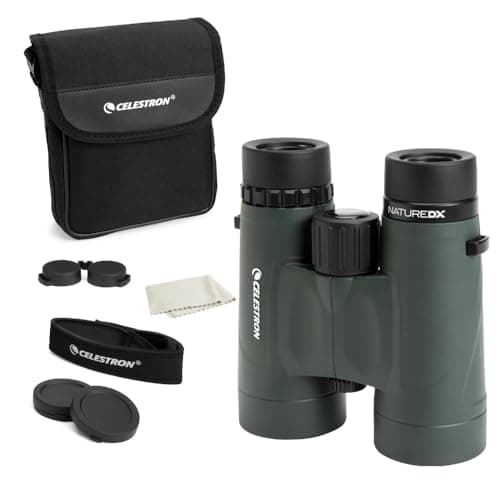

I was parked at a pullout somewhere along the Cades Cove loop, a damp October weekend in the Smokies, of course, when the person next to me pulled out a pair of binoculars and locked onto a black bear before I'd even gotten my doors open. That moment stuck with me. I'd been doing 47 parks with a cheap pair of roof-prism bins that fogged up every time temperatures dropped, and I finally decided to fix that. The Celestron Nature DX 8x42 is what I landed on after a lot of research and a little frustration with my own setup.
We may earn from qualifying purchases.
Where it shines
The 8x42 configuration is honestly the sweet spot for national park use. Eight times magnification gives you enough reach to pick out a peregrine on a cliff face without the image shake you get with 10x or 12x when you're breathing hard after a climb. The 42mm objective lenses pull in solid light, which matters a lot in the shaded canyon country of Zion or under a dense canopy in Olympic.
The fully multi-coated lenses and phase-coated BaK-4 prisms are the real headline here. Colors read true. Contrast is sharp. I've used cheaper bins where everything had a slightly greenish or flat cast, and these just don't do that. Edge-to-edge clarity is good, not perfect, but good enough that you're not fighting the glass when you're trying to track a bird.
The 7.4-degree field of view is wide enough to pick up movement quickly, which matters more than magnification when you're scanning a treeline or trying to follow something in flight. And the rubber-armored housing has held up to being tossed on the passenger seat of my 4Runner more times than I'd like to admit. It's waterproof and nitrogen-purged, so fogging hasn't been a problem even on cold, wet mornings. That alone puts it ahead of my old pair.
Check current pricing and availability at Amazon here, worth doing before you head to a park gift shop, where the same quality usually costs more.
Honest gripes
The tripod adapter socket is a nice-to-have, but the adapter itself isn't included, which feels like a miss at this price point. If you want to use these on a tripod for extended wildlife watching, budget for the extra piece.
My bigger complaint is the focus wheel. It works fine, but it's a touch stiff right out of the box, and the throw from close focus to infinity is longer than I'd like. When something moves fast and you need to refocus in a hurry, you're spinning that wheel more than feels natural. It loosens up with use, but it was noticeable the first few trips out.
The included neck strap is also pretty basic. It gets the job done, but after a full day in, say, Shenandoah, your neck knows about it. I swapped mine out for a wider padded strap after the first week. Not a dealbreaker, but it's an extra cost worth planning for.
Honestly, none of these gripes would stop me from recommending them. They're trade-offs at this price, not failures.
On the trail / in use
I've run these through a pretty solid range of conditions since picking them up. Morning birding in the Great Smoky Mountains, where the mist hangs in the hollows until 9 or 10 a.m., is where the fogproof build earns its keep. I've also brought them out to Badlands, where the light is brutal and flat, and the multi-coated lenses helped keep glare manageable.
The close focus distance handles well for butterflies and insects if that's your thing. The eye relief is workable with glasses on, though I wouldn't call it exceptional. I wear sunglasses most of the time outdoors and the twist-up eyecups dial down reliably, so no issues there for me.
Weight is low enough that I don't think twice about dropping these in a daypack. They don't need their own case system or a dedicated spot in a pack organizer. That practicality matters when you're already managing layers, water, and snacks for a long loop.
For trip planning purposes: these ship with a carrying case, lens caps, and a cleaning cloth. I'd still add a microfiber cloth to your kit because the included one is thin. And if you're heading somewhere with serious crowds, like Arches or the South Rim, these are discreet enough that you're not drawing extra attention at an already-packed overlook.
If you're ready to upgrade from a bargain pair or just want something that holds up across a lot of different park environments, grab the Celestron Nature DX 8x42 on Amazon and you'll be in solid shape.
These won't replace a $600 pair of Swarovskis, and I'm not pretending they will. But for the parks traveler who wants reliable glass without selling a kidney, they're a genuinely good pick. Do your homework on what you need, and don't buy more binocular than your trip actually calls for., Marcus
FAQs