
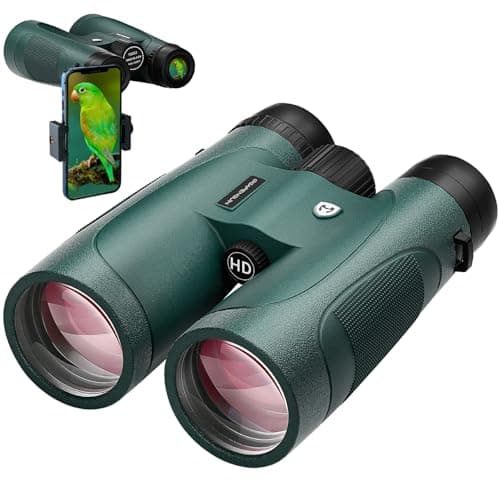

The moment I knew I needed a better pair of binoculars was a cold, overcast morning on the east side of Glacier, watching a grizzly work a hillside about half a mile out. My old 10x42s gave me a brown blur and a lot of wishful thinking. A 15x magnification with a 52mm objective lens would've told me whether that bear had a cub in tow. That's the specific itch the GIGAPENGUIN 15x52 binoculars are trying to scratch.
We may earn from qualifying purchases.
Out of the box
First impression: these are heavier than they look in product photos, though not unreasonably so for a 52mm objective. The build feels solid, rubber-armored, and the focus wheel has a satisfying, deliberate resistance. Nothing rattles.
The upgraded phone adapter is the accessory that sets this model apart, and I'll be honest, I expected it to be flimsy. It's not. The screw-lock mechanism and anti-slip rubber grip held my phone steady, and alignment took less than a minute once I figured out the centering. For capturing a distant raptor perched on a snag, or documenting a rare lifer for your bird list, it's genuinely useful. I've used clip-on adapters that vibrated loose after two shots. This one didn't budge.
The 22mm eyepieces are noticeably large. GIGAPENGUIN claims the image size runs about 1.5 times bigger than standard 16mm eyepieces, and subjectively, looking through them does feel roomier. The twist-down rubber eyecups work smoothly and lock at multiple positions, which matters if you wear glasses. I don't, but I handed these to a glasses-wearing colleague and she said the full field of view came through cleanly without vignetting.
BAK4 roof prisms with dielectric coating and fully multi-coated lenses are listed specs, and the low-light performance is the clearest evidence they're not just marketing words. I tested these at last light on a forested trail, the kind of murky dusk where most binoculars give you a muddy, gray image. Color fidelity held up well past what I expected. It's not night-vision, obviously, but for that final 20 minutes of shooting light, there's a real difference. Check current availability on Amazon.
Who this is for
If you're planning a trip to a park where distance is everything, think the Lamar Valley in Yellowstone, the open meadows of Rocky Mountain, or any coastal park where you're scanning for whales or seabirds, 15x magnification earns its keep. Standard 8x or 10x feels modest once you've spotted a wolf pack at 800 yards.
These are also a reasonable pick for birders who've outgrown entry-level glass and want better low-light performance without a $400-plus price tag. The phone adapter makes them appealing to social-media-minded travelers who want documentation shots. Cruise passengers and wildlife tour participants who mostly observe from a fixed position will appreciate the reach.
That said, 15x is not a casual magnification. At high power, hand tremor shows up. I'd recommend leaning against a tree, using a railing, or bringing a lightweight monopod if you plan extended glassing sessions. These aren't the pair you casually swing up on a moving subject. They reward patience and a stable platform.
After a few weeks
Here's my one real criticism: the focus wheel travel is long. Going from close focus to infinity takes more turns than I'd like, and in a fast-moving wildlife situation, that lag costs you. A bird flushing from cover, a marmot darting between rocks, anything that demands a rapid refocus will frustrate you. For static subjects, landscapes, or distant wildlife that's just standing there, it's fine. For active tracking, it's a weakness.
Waterproofing held up through a surprise afternoon thunderstorm near a trailhead. I didn't submerge them, but the seals handled sustained rain without fogging internally, which is the main thing you actually need on most park trips.
The included strap is standard-issue and shows the cost-cutting. After a week of full-day use, I swapped it for a padded aftermarket strap. Minor gripe, but worth knowing before you head out on a long day hike.
Overall, the optics punch above where the price likely sits, the phone adapter actually works, and the low-light capability is the real selling point for dawn-to-dusk park visitors. See the GIGAPENGUIN 15x52 on Amazon if you want the full specs and current pricing.
| Pros | Cons |
|---|---|
| 15x magnification excellent for long-distance wildlife viewing | Slow focus wheel travel frustrating on moving subjects |
| Strong low-light performance at dawn and dusk | Heavier than compact alternatives; monopod helps |
| Upgraded phone adapter is stable and practical | Included neck strap is thin and needs replacing |
| 22mm eyepieces provide a noticeably wide image | High magnification amplifies hand shake noticeably |
| Waterproof seals held up in field rain conditions | Price/rating data not confirmed; verify before buying |
If you're heading into Yellowstone, Glacier, or any park where your subjects are mostly small and far away, this is worth a serious look. Don't expect miracles with fast action, and swap that strap before day one. For unhurried wildlife glassing at the edge of daylight, I'd reach for these again.
— Jenna
FAQs