
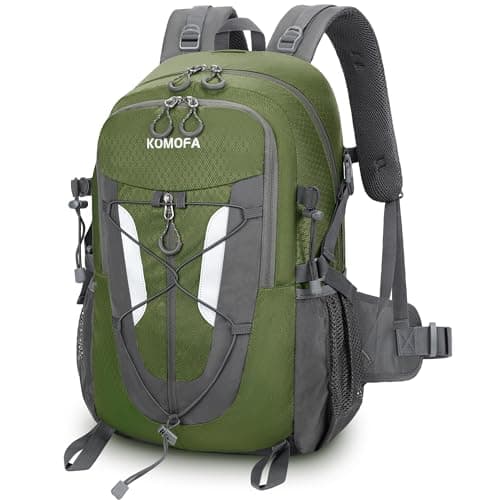
I've been eyeing lightweight daypacks for a while now, mostly because I spent too many summers at Glacier lugging a full-frame pack on trails where all I really needed was lunch, a rain layer, and a bear canister. A 30L daypack that doesn't weigh a ton and won't shred after a season of rocky scrambles sounds exactly right for that kind of use. The Komofa 30L crossed my desk recently, so I put it through its paces on some familiar Montana terrain and on a crowded weekend in the Tetons.
We may earn from qualifying purchases.
If you want the short version: check it out on Amazon and keep reading for what I actually think.
What I noticed first
Right out of the box, the army green colorway is understated in a good way. It doesn't scream "tourist," which matters when you're trying to blend into a trailhead parking lot rather than stand out like a neon flag.
The 420D nylon fabric feels reasonably solid. It's not the thickest material I've handled, but it's noticeably tighter-woven than a lot of budget packs in this category. I ran my thumbnail across it a few times and didn't see immediate pilling. Water-resistance is real but limited, as it's a DWR-style coating rather than true waterproofing. A sustained downpour on a ridge, the kind that rolls in off the Flathead Valley without much warning, would eventually soak through. Pack a dry bag for electronics.
The padded shoulder straps have decent loft for a pack at this price point. I noticed the sternum strap and hip belt right away, which is more than you get on a lot of daypacks this size. The hip belt is thin, so don't expect it to transfer much load, but it's genuinely better than nothing when you're carrying a full 30 liters.
Who should skip it
If you're doing anything more than a full day hike, this isn't your pack. I'd put the ceiling at around 8-10 miles with moderate elevation gain. Above that, you'll want a pack with a real framesheet and a more structured hip belt that actually carries weight off your shoulders.
Serious scramblers should also think twice. The 420D nylon will handle normal trail abuse, but if you're regularly dragging yourself over granite in Yosemite Valley or pushing through dense brush in Olympic, you'll want something built tougher. I've worn packs down to bare fabric on talus fields faster than I'd like to admit.
And if you run hot in humid conditions, the back panel is described as breathable, but I'd call it "better than a solid foam slab" rather than a true ventilated channel system. On a muggy August day in the Smokies, you're still going to have a sweaty back. That's just physics.
Here's my specific criticism: the hip belt is essentially decorative. It clips and it stays put, but it's so thin and lightly padded that on a loaded pack it does almost nothing to redistribute weight to your hips. For a true daypack under 20 lbs, it's fine. Load this thing up to 25 lbs and you'll feel it all in your shoulders by mile four. I'd rather Komofa had left it off entirely and saved the weight, or invested in something that actually works.
What works
The organization is genuinely good. There's a main compartment that handles the bulk of your gear, plus enough pockets that I could actually keep my snacks, headlamp, and first aid kit from all ending up in the same chaotic pile. Zippered side pockets fit a standard water bottle without a fight, which sounds basic but isn't always a given.
The lightweight build is a real advantage. When you're doing a quick out-and-back to a viewpoint and you don't want the pack itself eating into your energy budget, that matters. I've worn heavier daypacks and felt the difference by the end of a long day.
At this price, the value equation works for most casual park visitors. If you're planning a week at Zion, doing the Angels Landing permit hike one day and the Riverwalk the next, this handles both without complaint. It's also compact enough to stuff into a carry-on for the flight out, which I've done with similar-sized packs and appreciate every time.
The versatility claim holds up too. I've worn it off-trail and as a travel bag through airports. It doesn't look out of place in either setting, which isn't something I can say about every outdoor pack.
| Pros | Cons |
|---|---|
| Lightweight 420D nylon construction | Hip belt is too thin to actually transfer load |
| Good internal organization and pocket layout | Water resistance won't hold up in heavy rain |
| Sternum strap and hip belt included | Back panel breathability is modest at best |
| Compact enough for carry-on travel | Not built for scrambling or extended multi-day use |
| Understated colorway works on and off trail | No internal frame or framesheet |
In my experience, it's a solid buy for someone who wants a grab-and-go daypack for national park visits without spending a lot of money. It won't replace a technical pack, but it doesn't pretend to. You can find it on Amazon here and judge the current price for yourself.
If you're putting together a park trip and want a lightweight option that covers the basics, I don't think you'll regret it. Just know its limits before you head out. Grab the Komofa 30L on Amazon and leave the ultralight dreams for another day.
I'll keep using this one for shorter trail days and as a travel daypack. It's earned a spot in my rotation, hip belt complaints and all. Pack smart, check the weather, and enjoy the trail., Jenna
FAQs