
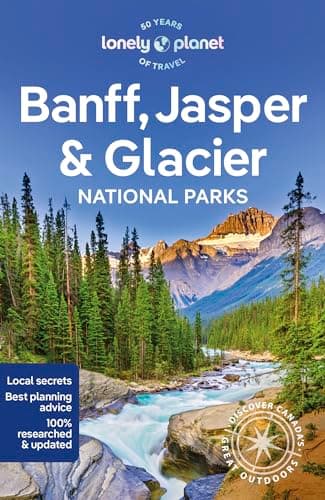

My last trip through the Going-to-the-Sun Road corridor was one of those weeks where the weather couldn't make up its mind. Smoke one afternoon, sun-soaked ridgelines the next, and a surprise hailstorm somewhere near Logan Pass that sent me scrambling for my rain shell. What I didn't scramble for fast enough was a solid regional guide. I'd been winging itineraries off half-remembered ranger briefings and spotty cell service, and I paid for it in missed connections and one very avoidable backtrack. That's how I ended up picking up the Lonely Planet Banff, Jasper and Glacier National Parks guide.
We may earn from qualifying purchases.
Compared to what I'd used before
Before this one, I'd been leaning on a mix of free park brochures, the NPS website, and an older Moon Guides title that a coworker left in the ranger station break room at Glacier. Moon's coverage is solid if you already know the parks reasonably well, but it leans more encyclopedic than practical. It tells you what's there; it doesn't always tell you how to string it together when you've only got five days and a craving to cross into Waterton Lakes.
That's where the Lonely Planet format earns its keep. The itinerary structure is genuinely useful. It thinks in days and logistics rather than just landmarks, which matters when you're planning around park entrance queues, timed entry permits, and the kind of afternoon thunderstorm windows that anyone who's spent a July in the Rockies knows to expect. I've used Lonely Planet guides abroad for years, and this one carries the same bones, adapted for a parks context that's more rugged than most.
If you're considering it, you can check current availability here. Pricing wasn't listed when I looked, so check the listing for the most current number.
What didn't click
Here's my honest gripe: the Canadian parks get the lion's share of the attention, and Glacier feels a little shortchanged. Banff and Jasper are sprawling, complex parks and they deserve deep coverage, so I get it. But if your primary destination is Glacier, you might find the U.S. coverage thinner than you'd like. Waterton Lakes gets a reasonable treatment given its size, but some of the Glacier trail-level detail I was hoping for just isn't there.
There's also no substitute for current conditions. A guidebook, by nature, can't tell you that a trail washed out last September or that a particular campground changed its reservation system. I've always said printed guides are your framework, not your field report. You still need to call the park or check the alerts page before you leave the trailhead parking lot. That's not a knock on Lonely Planet specifically, it's a limitation of the format across the board, but it's worth keeping in mind if you're the type who wants a single source of truth.
I also don't know the exact page count or physical dimensions off the top of my head, and Amazon's listing didn't surface those specs clearly, so I can't tell you whether it'll fit in a daypack's outer pocket or needs to ride in your main compartment.
What I actually liked
The "travel like a local" framing isn't just marketing padding. The insider tips throughout the book have a practical texture to them. Timing recommendations, crowd avoidance strategies, notes on shoulder-season access. These are the details that rangers tell visitors in passing and that don't make it onto park websites.
I particularly appreciated that the itineraries don't assume you're only hitting one park. The cross-border angle, covering the Waterton-Glacier International Peace Park corridor as a connected experience, reflects how people actually travel this region. Many visitors who come through Glacier are already road-tripping from Banff or headed that direction. A guide that acknowledges that geography is more useful than one that treats each park like an island.
The writing is cleaner and less bloated than some editions I've read. It doesn't bury the useful stuff under thick prose. Short, direct paragraphs with clear headers make it easier to flip through in a cramped car or a dim tent. And honestly, for planning a multi-park trip that spans two countries and covers everything from high-alpine hikes to lower-elevation lake loops, having a single coherent reference is worth something. I'd rather carry one book with good bones than juggle four browser tabs at a campground with no signal.
If this region is on your radar, grab the Lonely Planet guide and use it as your starting framework, then layer in current conditions from the parks themselves.
| Pros | Cons |
|---|---|
| Day-by-day itinerary structure that actually works for multi-park trips | Glacier National Park coverage feels thinner compared to the Canadian parks |
| Cross-border coverage of Waterton-Glacier corridor | Can't reflect real-time trail conditions or permit changes |
| Practical insider tips beyond standard park literature | Physical specs (dimensions, page count) unclear from Amazon listing |
| Readable layout, easy to navigate on the road | Price not listed at time of review, check the current listing |
I'm not someone who hypes up a product just because I used it. I've left guidebooks in donation boxes at hostel lobbies when they didn't earn their space in my pack. This one's staying on my shelf, at least through my next planning season. Use it for what it is: a smart, structured starting point for a region that rewards preparation. Then get outside and let the parks do the rest., Jenna
FAQs