
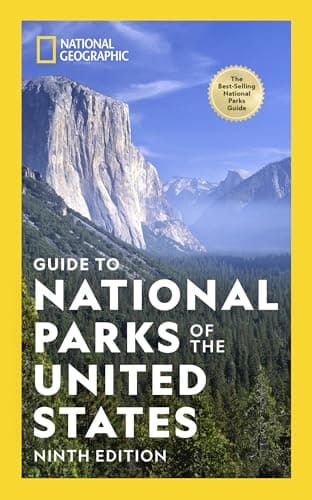
National Geographic's National Parks Guide Still Earns a Spot in My Pack

My first summer at Glacier, I showed up with a mix of printouts, dog-eared paperbacks, and optimism. By July, most of those printouts were pulp from a surprise afternoon thunderstorm, and the paperbacks had fallen apart at the spines. That's when a fellow ranger slid a copy of the National Geographic Guide to National Parks across the table at the Lake McDonald Lodge break room. I've kept a copy within reach ever since. If you're planning a serious trip to even one of the parks, you need something more than a phone and a wing-and-a-prayer data connection at the trailhead.
We may earn from qualifying purchases.
The National Geographic Guide to National Parks of the United States, 9th Edition was revamped in time for the National Park Service's 100th anniversary. That timing matters. Coverage is current, and the maps reflect updated trail infrastructure and entrance information that older editions simply don't have. Grab it here on Amazon before your next trip.
Compared to what I'd used before
Before this guide, I bounced between Fodor's regional titles, individual park brochures, and whatever the visitor center had on the rack. Each had its niche. Fodor's is fine for someone whose idea of roughing it is a hotel without a spa, but it's light on trail-level detail and practical logistics for people who actually want to spend time in the backcountry.
The National Geographic edition is different in a few important ways. First, it covers all 59 major national parks in a single volume, which means you're not juggling three books on a road trip that hits Zion, Bryce, and the North Rim in one swing. Second, the cartography is genuinely good. National Geographic has been making maps for over a century, and it shows. Topo context, road access, and key landmarks are readable without a magnifying glass, which I can't say about every competing guide I've tried.
The prose is also written for people who intend to actually go outside, not just read about going outside. Practical trail recommendations, wildlife notes, best-season guidance. That's the stuff I'd want a first-time visitor asking me about at the ranger station, and it's mostly here.
Where it falls short
Honestly, my biggest gripe is the depth per park. When you're trying to cover every major park in one book, something has to give, and here it's granularity. If you're heading to a park you've never visited and you want a solid overview, this guide delivers. But if you're going back to a place you love and want to find that lesser-known drainage or the permit-required route that most visitors skip, you'll hit a wall pretty quickly.
For my money, anyone doing more than two or three nights in a single park should supplement with a park-specific guide or a good topo map set. This book is a starting point and a trip-planning tool. It's not a field companion for experienced hikers who already know the main attractions and are hunting for the edges.
The lack of a listed price on Amazon at the time I checked made it a little hard to comparison-shop, so look at the current listing carefully. Physical condition on arrival can also vary with used copies, so I'd recommend ordering new if you're relying on the maps.
What I actually liked
The photography is exactly what you'd expect from National Geographic, which is to say it's stunning and also genuinely useful. A good photograph of a landscape tells you something about light, season, and terrain that a paragraph of text can't fully convey. I've used the images to orient myself before trips more than once.
I also appreciate the "don't miss" and "good to know" callouts throughout. They read like tips from someone who's actually been there, not bullet points assembled from press releases. For a traveler hitting multiple parks in one summer road trip, those sidebar highlights save real time.
The 9th edition's revamp means you're not working with outdated entrance fee information or defunct campground listings, which was a real issue with older copies I'd seen passed around among seasonal staff. That freshness alone justifies buying the current edition over hunting down a cheaper older copy.
If you're building out a trip to even three or four parks, pick up the 9th Edition on Amazon and use it as your master planning document. Pair it with park-specific maps once you've narrowed down your itinerary.
This guide won't replace time on the ground or a conversation with a ranger who knows the current conditions. But as a single-volume reference for the breadth of the National Park System, it's the best I've used and the one I'd hand to a friend before their first big parks trip. It earns its weight., Jenna
FAQs