
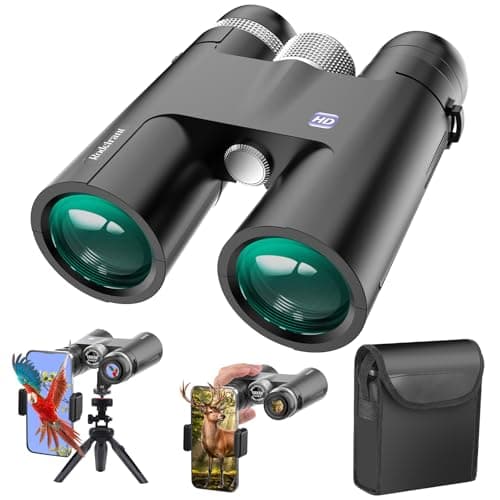

A damp November morning at Great Smoky Mountains, fog sitting low over Clingmans Dome, and a black bear I almost missed because my old binoculars had fogged up beyond usefulness. That's the context I kept coming back to when I started testing the Rodcirant 18x50 binoculars. I've dragged bins through 47 parks now, and honestly, the number of times weather has ruined a sighting is embarrassing. I wanted something that wouldn't quit on me.
We may earn from qualifying purchases.
Where it falls short
Let me get the honest stuff out of the way first, because no piece of gear is perfect and anyone who tells you otherwise is selling something harder than binoculars.
18x magnification sounds impressive on a spec sheet. In practice, it's a double-edged thing. At that power, any hand tremor turns the image into a shaky mess, which means the included tripod isn't optional, it's basically required for steady viewing. That's extra gear to pack, extra time to set up, and if you're like me you're already juggling a day pack, trekking poles, and a permit printout. The tripod itself feels adequate but not confidence-inspiring. The legs are lightweight to the point of feeling a little flimsy on uneven ground, which is exactly the ground you'll be standing on in most parks.
The phone adapter is a genuine addition, and I appreciate that Rodcirant included it. But getting a smartphone seated and aligned took me several frustrating minutes the first time. Quick-draw wildlife shots, it is not. By the time I had my phone locked in and the image centered, the elk I was watching had moved on. That's a real-world limitation worth knowing before you buy.
Price isn't listed on the Amazon page right now, so I can't give you a direct comparison number. Keep that in mind as you shop.
How it stacks up
For context, I've used mid-range binoculars from a couple of well-known optics brands on park trips, and the Rodcirant holds its own better than you'd expect from a lesser-known name. The BaK4 prisms and fully multi-coated lenses aren't just marketing copy. BaK4 glass is a real quality indicator, and combined with phase coating on the prisms, you do get noticeably brighter images than cheaper BK7-prism alternatives in the same price class.
The 399 ft / 1,000 yds field of view is workable. It's not as wide as lower-magnification bins, but that's physics, not a flaw. You trade field width for reach when you go to 18x. If you're scanning a meadow at Yellowstone for bison, you'll notice the narrower sweep. If you're locked onto a peregrine on a canyon wall, you'll appreciate the magnification.
The 1.1-pound weight is a genuine plus. I've carried heavier binoculars that left my neck aching by mile eight. These don't do that. For day hikes where every ounce counts, the weight is a real consideration, and Rodcirant got it right.
Check current availability and pricing at the Amazon listing here before you compare, since the market on budget optics shifts fast.
Where it shines
Honestly, the waterproofing is where these earn their keep for me. IPX7-rated means they can handle submersion, not just a rain shower. The rubber-armored polycarbonate housing feels solid in hand, not plasticky. I've held bins at this price point that felt like they'd crack if you looked at them wrong. These don't give that impression.
Fogproofing matters more than most buyers realize. Internal fogging happens when you move between temperature extremes, say, a cold car to a warm trailhead at sunrise in the Smokies. A fogged eyepiece is useless. These stayed clear through a chilly morning where my coffee mug was steaming.
The 19mm large eyepieces are genuinely comfortable, especially if you wear glasses. Glasses wearers often get a cramped, vignetted view through smaller eyecups. The larger eyepieces help. I don't wear glasses myself, but a hiking partner who does tried these and immediately noticed the difference from her usual pair.
Low-light performance is better than I expected. Dawn and dusk are prime wildlife hours in every park I've visited, and these handled that soft light with more clarity than I'd have guessed. The 99.9% light transmission claim sounds like marketing, and maybe it is, but the results in the field were genuinely usable at times when cheaper optics start looking muddy.
If you're planning a trip where wildlife viewing is a priority, these are worth a look. Grab them on Amazon and check whether the price makes sense for your budget when you land on the page.
| Pros | Cons |
|---|---|
| BaK4 prisms with multi-coated lenses for bright, clear images | 18x magnification requires tripod for steady hand-held use |
| IPX7 waterproof and fogproof housing | Tripod legs feel lightweight on uneven terrain |
| Lightweight at 1.1 lbs for all-day carry | Phone adapter setup is slow for spontaneous wildlife shots |
| Large 19mm eyepieces comfortable for glasses wearers | Price not currently listed on Amazon page |
| Includes phone adapter, tripod, and tripod adapter | Narrower field of view than lower-magnification alternatives |
If you're hitting parks where distances are big and wildlife doesn't come to you, these binoculars do more right than wrong. I'd still rather have the tripod stay home, but that's a tradeoff baked into any high-power optic. Pack them in your 4Runner, keep them in a dry bag just in case, and don't expect miracles from the phone adapter. You'll be fine., Marcus
FAQs