
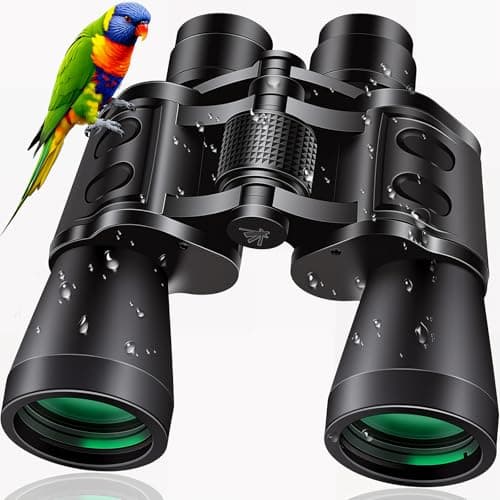

A damp spring morning at Cades Cove, that's where I first wished I'd had something with real reach. I was standing at the edge of the field loop in the Smokies, watching what I was pretty sure was a black bear about half a mile out, and my old 8x42s just weren't cutting it. The bear was a smudge. A promising smudge, but a smudge. That's the kind of moment that sends you looking for something with more magnification, and that's how I ended up with the Sfeoot 20x50 binoculars rattling around in my 4Runner's back seat.
We may earn from qualifying purchases.
Out of the box
The Sfeoot 20x50s come packaged with a carrying case and a strap, which I appreciated right away. You'd be surprised how many budget binoculars ship with one or the other but not both. The body has a rubberized coating that feels solid, not hollow, and the grip texture on the side handles is genuinely good, with a concave-convex pattern that keeps things from sliding around when your hands are sweaty or damp from morning mist.
The 20x magnification paired with a 50mm objective lens is the main draw here. That combination pulls in a fair amount of light and gives you a claimed 1,000-yard field of view, which is legitimately useful when you're glassing a distant ridgeline for elk or trying to track a raptor across an open valley. The BAK-4 prisms and FMC-coated lenses are the right spec choices at this price tier. BAK-4 glass produces cleaner, rounder exit pupils than the cheaper BAK-7, and the multi-layer coatings help hold contrast when the light isn't cooperating.
Focusing is handled by a center wheel that's rubber-coated and moves smoothly. I was able to dial in a sharp image pretty quickly, even one-handed, which matters when you're also trying to hold a trail map or a granola bar. The daily waterproofing is a nice-to-have, though I'd treat it as splash-resistant rather than submersible. Rain? Fine. Dropping them in the creek? Don't.
Check current pricing and availability at Amazon here before you commit.
Honest gripes
Here's the thing about 20x magnification that nobody in the marketing copy mentions: it amplifies everything, including your hand shake. I don't care how steady you think you are, holding 20x glass freehand for more than a few seconds turns a crisp image into a wobbling mess. Honestly, if you're planning to use these for serious wildlife watching from a fixed position, bring a monopod or a trekking pole you can brace against. Freehand is fine for quick looks, but extended glassing sessions are frustrating without some kind of support.
My other gripe is the eye relief. I wear glasses, and the eye relief on these felt tight. I had to press in closer than I wanted to get the full field of view, which left little smudge rings on my lenses. If you wear glasses full-time, test them before your first big trip. The eyecups are adjustable, but there's only so much they can do.
The carrying case is functional but basic. It's stiff enough to protect the optics, but I wouldn't trust it to survive getting sat on in a crowded shuttle bus to a trailhead, which is a very real risk if you've ever dealt with the Zion Angel's Landing permit crowd. These are small complaints overall, not deal-breakers, but you deserve to know going in.
Who this is for
These binoculars make the most sense for a specific kind of park visitor: someone who does a lot of open-country scanning from overlooks, meadow edges, or pull-offs, and who doesn't want to spend a lot of money to do it. If you're planning a trip to places like Yellowstone's Lamar Valley, the Tetons, Big Bend, or Canyonlands, where wildlife can be hundreds of yards away on open ground, the extra reach of 20x is actually worth having. It's not what I'd grab for dense forest birding where subjects are close and fast-moving, but for big views and distant subjects, it earns its place in the pack.
It's also a decent pick for anyone who does double duty: wildlife watching plus sporting events or concerts. The versatility is real. I've used a similar setup at a college football game and it worked just as well as at a park overlook.
Budget-conscious first-timers who aren't ready to drop serious money on a premium European optics brand will find these a workable entry point. The BAK-4 prisms and FMC coatings put them above the cheapest stuff on the shelf without jumping to a price that stings. If you're curious, grab them on Amazon and decide for yourself.
| Pros | Cons |
|---|---|
| BAK-4 prisms and FMC lenses for the price | 20x magnification amplifies hand shake badly |
| Rubberized, non-slip grip that actually works | Tight eye relief, rough for glasses wearers |
| Includes both carrying case and strap | Carrying case is basic and not crush-proof |
| Smooth, one-finger center focus wheel | No listed diopter adjustment specs |
| Daily waterproofing handles real-world conditions | Not suitable for submersion |
Honestly, the Sfeoot 20x50s aren't going to replace a serious pair of Swarovskis or even a mid-tier Vortex, and I don't think they're trying to. For what they are, a budget-friendly, high-magnification option that covers wildlife, travel, and stadium use, they hold up. Pack a monopod, manage your expectations on the eye relief if you wear glasses, and they'll do real work for you in the parks.
I've got 16 more parks to hit before I can say I've seen them all. These are going in the truck., Marcus
FAQs