
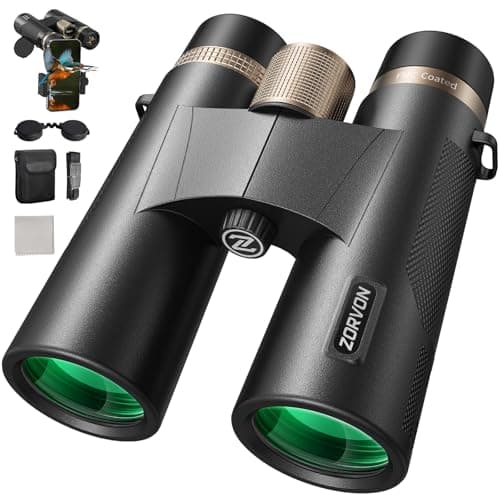
It was a damp, grey morning somewhere along the Appalachian foothills, the kind of pre-dawn start where you're stumbling out of the 4Runner with cold coffee and trying to get eyes on a black bear before the parking lot fills up with tour buses. My usual binoculars had fogged up the night before in the condensation, and I was stuck squinting. That's the exact moment I started paying closer attention to fog-proof, waterproof specs. When the ZORVON 10x42s landed on my radar, I figured they were worth a long look.
We may earn from qualifying purchases.
I've now carried these through a handful of outings, including a soggy stretch in the Smokies and a drier trip out west. Here's what I actually think, no sales pitch, just what I noticed.
Who this is for
Honestly, these are aimed squarely at the traveler who wants solid optics without spending Swarovski money. If you're the kind of person who books a week at Yellowstone, packs light, and needs one pair of binoculars that can handle elk at distance in the morning and warblers in the treeline by afternoon, the ZORVON 10x42 makes a reasonable case for itself.
The 10x magnification is a practical choice for open-country parks like Grand Teton or Arches, where you're often glassing across wide valleys or canyon rims. It's also manageable enough to hold steady handheld, which matters when you've been on your feet since 6 a.m. and your arms aren't exactly fresh. The 17.1mm eye relief means eyeglass wearers don't get shut out of a comfortable view, which is genuinely useful since a lot of folks I meet on trail wear glasses and hate fighting their binoculars.
If you're a serious birder who grades every pair against a benchmark and logs field notes by species, you might want to move up to a higher-end brand. But for the park visitor who wants dependable glass to spot wildlife without a second mortgage, this hits a practical middle ground. Check current availability on Amazon.
Honest gripes
The weight is my main complaint. At about 1.5 lbs, these aren't heavy by some standards, but they're not featherweights either. After a full day hiking, say, a long out-and-back at Olympic or a ridge walk in Shenandoah, a neck strap-mounted binocular at this weight starts to nag. I'd strongly recommend a harness-style strap over the included neck strap if you're doing serious mileage.
The included carrying case is fine, but it's soft-sided and honestly feels like an afterthought. It's not going to survive getting shoved around in a crowded gear bag indefinitely. A more structured case would have been worth a few extra dollars in the packaging.
I also couldn't find verified third-party data confirming the IPX7 waterproof rating through independent testing. The nitrogen-filled fog-proof construction checks out as a standard feature at this price tier, but I'd treat the waterproofing claim as "rain-resistant and fog-proof" rather than "submersion-ready" until there's more field data. Don't drop these in the river and expect miracles.
What I actually liked
The ED glass and BAK4 prisms combo is the real story here. Chromatic aberration, that color fringing you see around high-contrast edges like a hawk against a bright sky, is noticeably controlled. Images stay clean at the edges, which is something cheaper glass in this magnification range often fumbles. The fully multi-coated lenses pull in decent light at dawn and dusk, which are peak wildlife hours in most parks I've visited.
The 23mm eyepieces feel generous. You get a wider, more immersive view than you'd expect at this price, and the eye relief makes extended glassing sessions actually comfortable rather than a squint-and-flinch situation. I spent a solid hour scanning a ridgeline in the Smokies one morning and didn't finish with the usual eye-strain headache I get from lesser glass.
The build feels sturdy enough for normal trail use. It's not a delicate instrument, and it doesn't feel like one. The rubber armor grips well even with damp hands, and the focus wheel has a smooth, responsive action without being so loose it shifts in the bag.
For the price bracket these sit in, I think they punch reasonably well. They're not going to replace a dedicated pair from a premium optics house, but they're a legitimate option for the park-goer who wants reliable glass on a practical budget. See the ZORVON 10x42 on Amazon if you want to dig into the specs yourself.
| Pros | Cons |
|---|---|
| ED glass reduces chromatic aberration noticeably | 1.5 lbs gets tiring on long hiking days |
| BAK4 prisms improve brightness and contrast | Included carrying case feels flimsy |
| 17.1mm eye relief works for eyeglass wearers | IPX7 waterproof claim lacks independent verification |
| Nitrogen-filled fog-proof construction | Included neck strap not ideal for full-day use |
| Fully multi-coated lenses for low-light performance | No tripod adapter included |
I'm not going to tell you these are the only binoculars worth buying, that's not how gear works, and you probably already know that. But if you're heading into a national park and want a pair that handles fog, rain, and low-light mornings without a huge outlay, the ZORVON 10x42 is worth your time. Grab a pair on Amazon before your next trip and see how they hold up for yourself. Just swap out that neck strap on day one. You'll thank me later., Marcus
FAQs